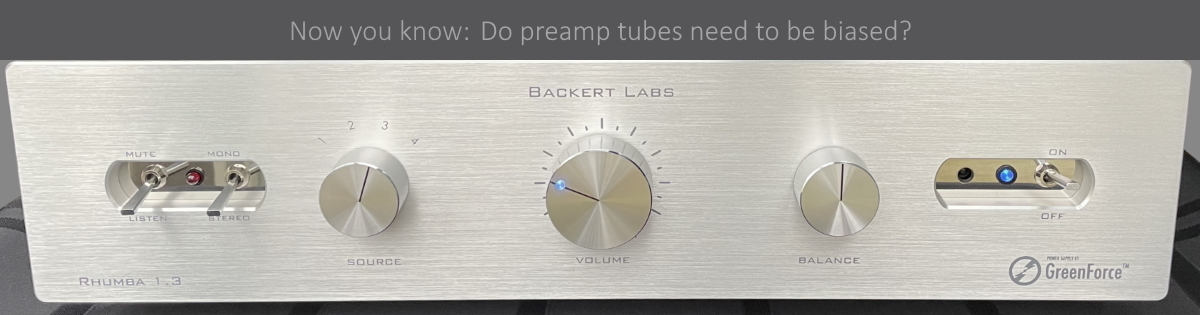
So, we at Backert Labs often mention that one of the goodies found in our top 2 linestages (the Rhythm and the Rhumba Extreme) is that they automatically and continuously adjust the bias for any 12AU7 tube you might insert.
Our phono stage does this too (the Rhumba Xphono).
But the entry-level Rhumba doesn’t feature automatic bias correction.
So, is it really necessary to bias preamp tubes?
There are actually two answers to this question:
- No. It’s not necessary to bias preamp tubes.
While it is essential to bias the power tubes in a tube power amp, to avoid overheating (which can damage the amp) and/or very bad sound, preamps don’t require you to bias the tubes.
In fact, biasing the tubes on a preamp is so unheard-of, preamps don’t even allow you to bias the tubes. It’s just, “not a thing” in the world of tube preamps. You can play music for the entire life of a preamp (or the entire life of its tubes) and never bias anything, because a preamp tube that is incorrectly biased will never harm the preamp.
So there’s your first answer. It’s not necessary.
The second answer:
2. However, it is helpful to bias preamp tubes.
Here are the two main advantages of maintaining proper bias for your tubes at all times:
A. The tubes will last longer.
B. Automatic bias correction won’t actually “make tubes sound better,” but it will keep them from sounding worse by ensuring they operate within the intended voltage range for their entire lives.
What does this mean?
Well, the designer of the preamp designed it to have “X” volts going through the tubes, to make your music sound its best. Incorrect bias means that the tubes will have “X plus something” volts, or “X minus something” volts going through them. If the bias voltage is too far off, the sound quality of the preamp will be affected.
Different tubes require different amounts of bias to achieve the overall correct voltage that the designer intended for the circuit.
Bottom line: bias is an amount of voltage. Incorrect bias means the tubes have an incorrect amount of voltage going through them as they amplify your music. Voltage on the tube that is too far off from what the designer intended will indeed have an effect on sound quality.
And that’s how not correcting bias can make your preamp sound worse. If you only replace your tubes with other tubes that want the “factory level” of bias, you’ll always have optimum sound quality. It’s when you insert a tube that wants a very different amount of bias that sound quality can suffer — unless the bias is corrected.
You may have noticed the words “ensuring they operate within the intended voltage range for their entire lives.” We included that concept because even tubes that want the stock level of bias provided by the factory will start to want different amounts of bias as they age. Automatic bias correction ensures they will keep sounding their best all the way to the end of their lives.
Conclusion. While not adjusting tube bias will not damage your preamp, keeping your tubes properly biased can extend their life, and ensure your preamp always sounds its best, no matter which tubes you choose.
Questions? You can always give us a call, or write to us at c o n s u l t @ b a c k e r t l a b s . c o m.