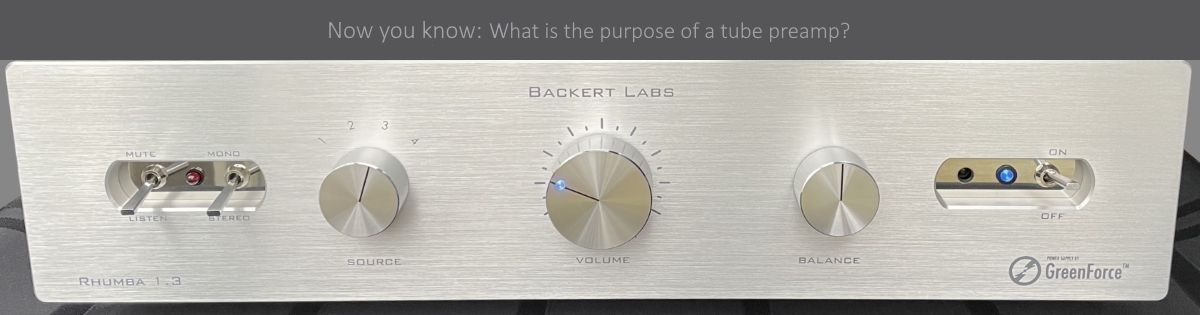
1. What is a preamp?
A preamp, or a preamplifier, is a part of a chain of devices that produce a music signal for your stereo and at least has the ability to “turn down the volume” of the music signal.
(Here we’ll focus on home stereo preamps, but there are other types, including microphone preamps used in recording studios and live music settings, and preamps for guitar and bass amps.)
The Easy Version: A preamp is basically a box that lets you:
– feed several sources of music into it… DAC, turntable, CD player, etc.
– select which music source you want to listen to.
– and adjust the volume all the way down to silence.
Some preamps, called “active” preamps, also allow you to *amplify* the music signal, in case the volume of your source is not enough to properly drive your power amp. All Backert Labs preamps are active.
Other features in some preamps include balance adjustment between the 2 speakers, tone controls, muting controls, and stereo/mono switches.
Why preamps are critical:
A preamp takes the music at its very source and provides the first level of adjustment or amplification the music will see as it makes its way to your speakers. If that first stage of amplification isn’t perfect, even the greatest power amp + speakers on Earth will never be able to “put it back together” and make it sound great.
2. Why do people talk about “tube” preamps?
A preamp’s amplification of music can be provided by solid-state devices (i.e. transistors) or can be provided by tubes, as is the case with Backert Labs preamps. (See photo.)
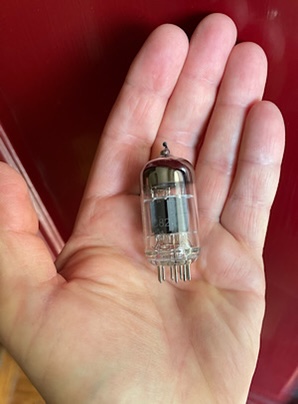
A tube — this one is a 12AU7, which is what we use in most Backert Labs preamps
There is nothing functional that tube preamps do which solid-state preamp can’t do. They both let you select different music sources, and control volume. They mainly just sound different. So the choice of a tube vs. solid-state preamp is really up to you, and your musical tastes. What are the sonic differences?
Stereo-Types
Tube: The stereotype “tube sound” is round, warm and smooth, but this is really a myth — those warm, smooth tunes came out of classic tube preamps and amplifiers because of the circuits that the designers used. A tube preamp can sound very detailed and bright, or very deep and full of bass, or very neutral, or any way the designer wants it to sound.
Solid-state: The stereotype “solid-state sound” is very detailed with super-clear high frequencies (treble) and very low bass, but an overall “grey” sound that is less engaging and less layered, especially in the midrange. But again, that’s just the stereotype. It’s possible to build very 3-D sounding and colorful solid-state circuits that have glorious midrange.
What kind of “damage” can a merely average preamp do to your music? Well it can introduce phase shift or impedance problems. These problems can take away the feeling that the music is life-like, or they can simply rob your system of bass. Lesser preamps can “fog up” the sound quality, or make music flat, grey, lifeless, and sterile. And many preamps will subtly impair the timing of your music, so what you hear ends up sounding slow, or simply, “like a stereo”.
Therefore a good preamp is critical to your musical enjoyment. This is why we believe that the preamp-like functions in DACs and CD players are very often not good enough. And it’s why we at Backert Labs make nothing except preamplifiers.
It’s why we are the preamp specialists.
Any questions? Just give us a call, or write to us at c o n s u l t @ b a c k e r t l a b s . c o m.